AI Adoption in S&P 500 Firms
July 2026
Yang Yu, Martin Fleming, Lucy Hampton, Christophe Combemale, Neil Thompson
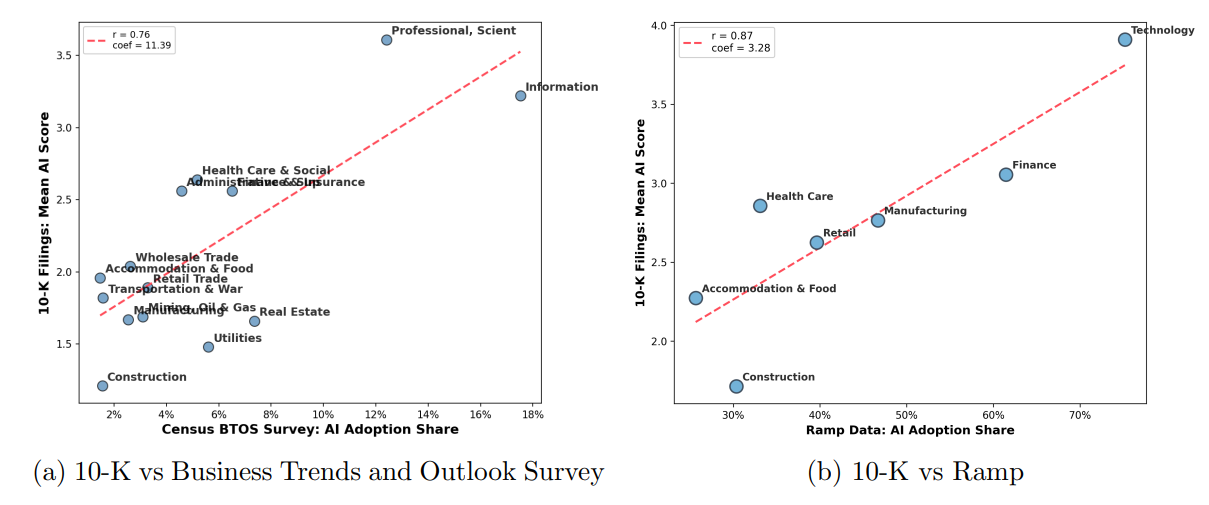
The adoption of artificial intelligence (AI) by large enterprises is an important potential source of aggregate productivity improvement and labor market impact. We study AI adoption of S&P 500 firms over the period 2016 to 2025, estimating adoption at the enterprise level. While generative AI tools are useful for personal and professional applications, our focus is on the deep integration of AI in the business processes of large enterprises which are bellwethers for firm adoption more broadly. We develop a novel measure to assess deep AI adoption (and distinguish it from AI hype) that is based on SEC 10-K filings, where laws and regulations ``prohibit companies from making materially false or misleading statements." In 2025, 11% of S&P 500 enterprises had AI deeply integrated into their business processes, and a further 10% were using AI in the production of goods and delivery of services. AI adoption has more than quadrupled from 5% in 2022 with slowly accelerating adoption among non-technology firms but very aggressive adoption in the technology sector which accounts for two-thirds of deeply integrated enterprise adoption. Firm profitability shows a "J-curve" as firms move from no adoption to deep adoption, but we observe no differences in capex or productivity. Among technology firms, but not others, AI adoption is higher for firms with more employees and higher values of Tobin's q.