There's plenty of room at the Top: What will drive computer performance after Moore's law?
June 2020
Charles E. Leiserson, Neil Thompson, Joel S. Emer, Bradley C. Kuszmaul, Butler W. Lampson, Daniel Sanchez, Tao B. Schardl
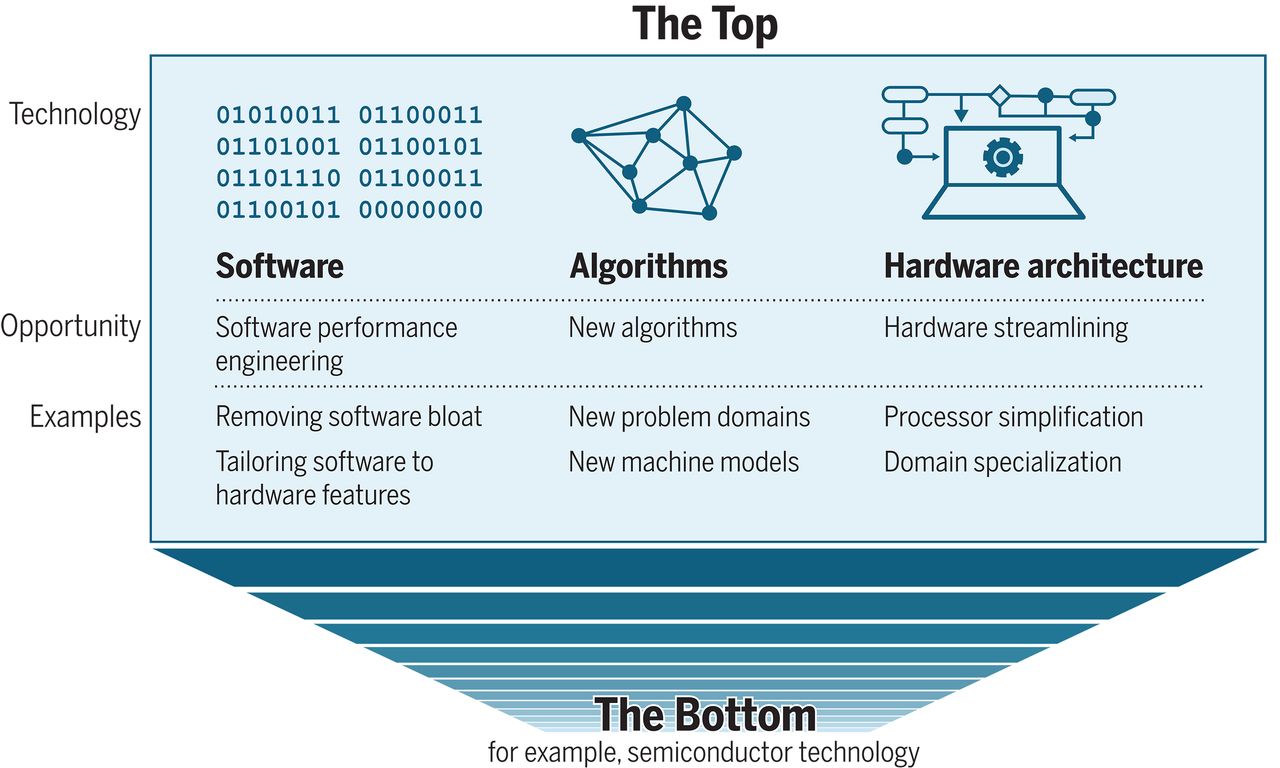
The miniaturization of semiconductor transistors has driven the growth in computer performance for more than 50 years. As miniaturization approaches its limits, bringing an end to Moore's law, performance gains will need to come from software, algorithms, and hardware. We refer to these technologies as the "Top" of the computing stack to distinguish them from the traditional technologies at the "Bottom": semiconductor physics and silicon-fabrication technology. In the post-Moore era, the Top will provide substantial performance gains, but these gains will be opportunistic, uneven, and sporadic, and they will suffer from the law of diminishing returns. Big system components offer a promising context for tackling the challenges of working at the Top.