AI in Science: Early Insights
September 2026
Mihai Codreanu, Alex Imas, Juan Mateos-Garcia, Joseph Emmens, Evalyne Muiruri, Arthur Turrell, Julian Jacobs, Atoosa Kasirzadeh, Ana Trišović, Yiyuan Chen, Tanya Rodchenko, Catherine Pollard, Scott Strand, Daniel Rock, Zanna Iscenko, Fabien Curto Millet, Neil Thompson, James Manyika
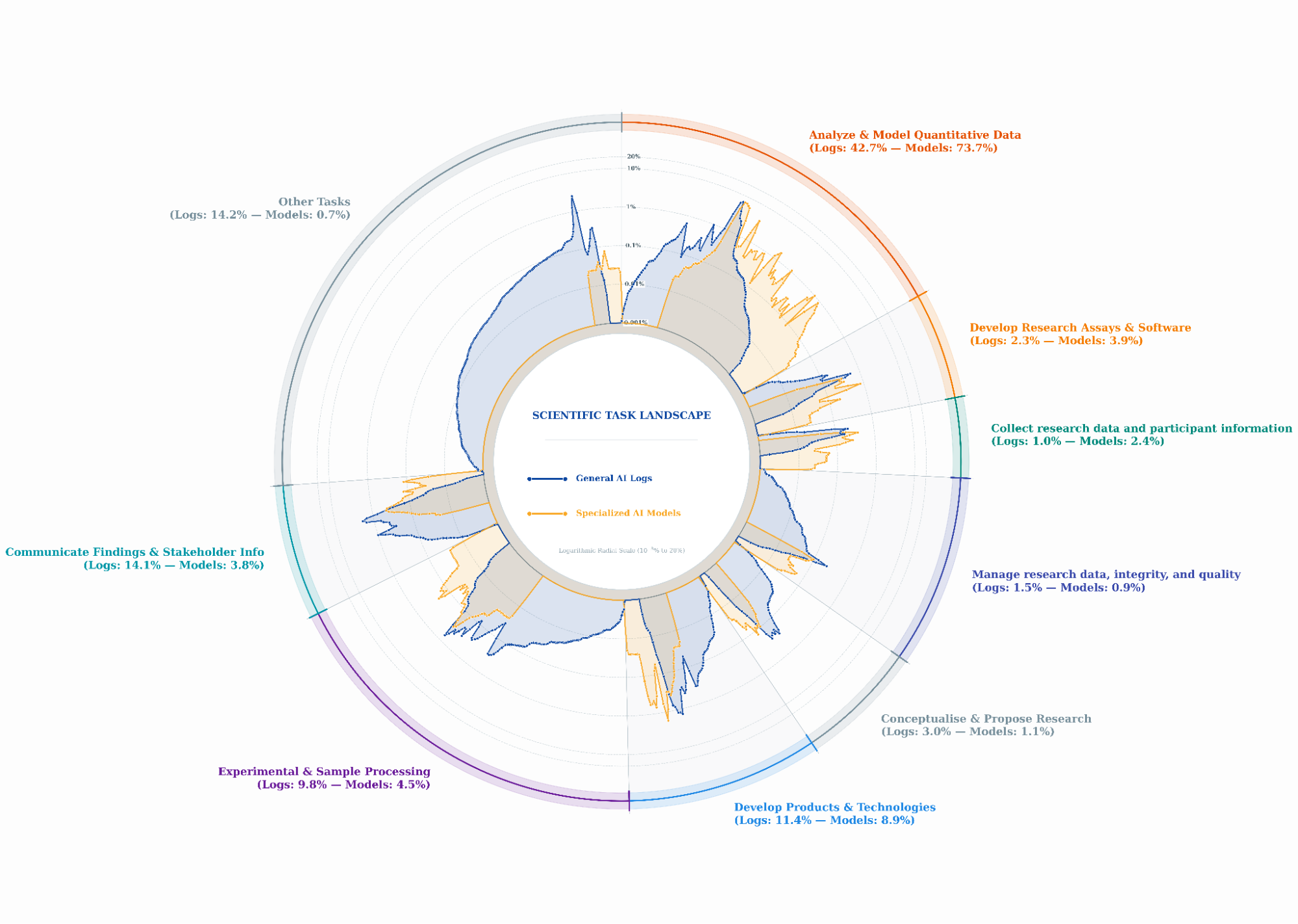
Scientific progress is a key driver of economic growth and prosperity. There is great excitement - but also concerns - about the impacts of AI on science, but so far little data. We provide early insights on this from three data sources: a sample of 15 million Gemini interactions, an inventory of over 2,600 specialized AI models across disciplines, and a survey of over 600 scientists. We map these data to a new taxonomy of scientific tasks to study how scientists are using AI. Four main findings emerge. First, we find broad adoption and coverage: scientists use AI more than most other occupations. Specialized AI models have broad disciplinary coverage and are highly cited. Nearly half of the scientists surveyed report using some form of AI every day. Second, we document evidence that LLMs (proxied through Gemini usage) and specialized models act as complements–LLMs are used for general analysis, coding, and manuscript preparation, while specialized models provide domain-specific predictions, data generation and classification. Third, scientists report large productivity gains from using AI: a saving of nearly 7 hours per week, time which is primarily re-invested in more research. Finally, we show that AI is already changing the scientific process. As some stages of scientific research become easier, bottlenecks shift downstream. Scientists report an increased backlog of untested hypotheses and substantial demand for output verification. Our findings suggest that AI holds significant potential to increase scientific productivity. However, as with other sectors, its ultimate impact will be governed by complex task interdependencies and investment into the elimination of emerging bottlenecks.








.png)
.PNG)